
Einstein Foundation awards grants to five researchers at Humboldt-Universität
The Foundation is strengthening Berlin as a centre of science and research while also supporting its international connectedness
Einstein Chair
Focus on Algebraic Curves
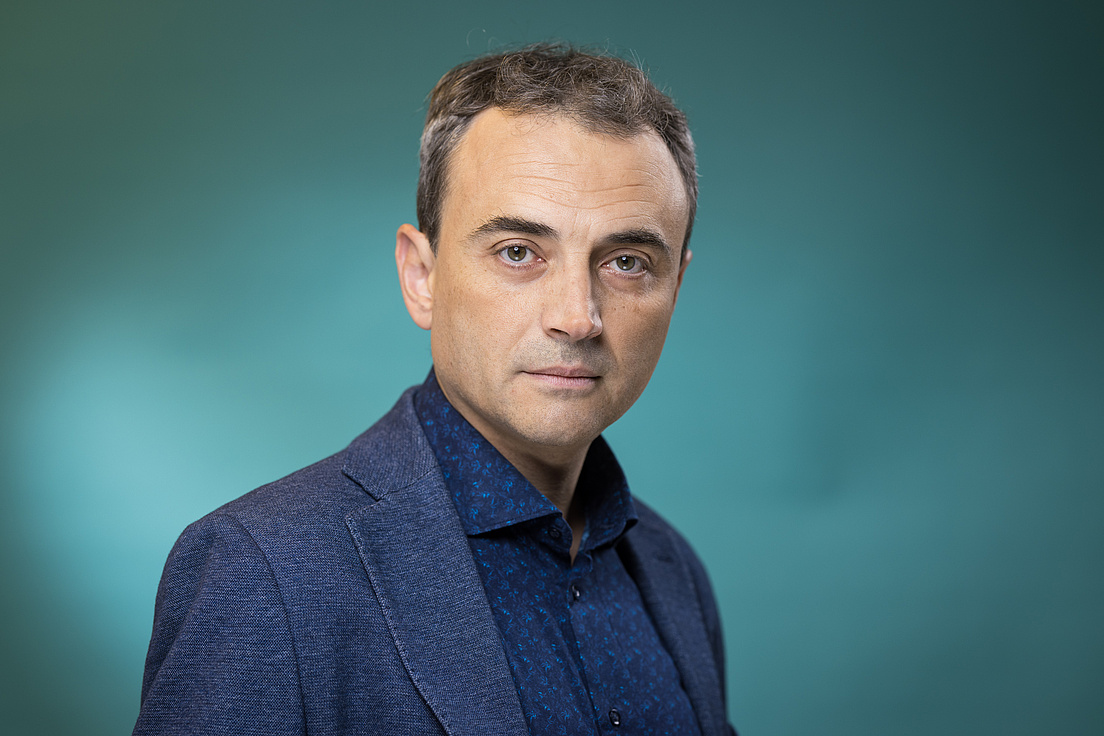
Gavril Farkas, Professor of Algebraic Geometry at Humboldt-Universität since 2007, is to become an Einstein Professor. He is regarded as one of the world’s leading experts in the field of the theory of algebraic curves and module spaces in algebraic geometry. Algebraic curves, which were introduced almost two centuries ago, are central objects in numerous areas of mathematics and theoretical physics. In his research, he addresses fundamental mathematical questions concerning the structure and classification of such curves, as well as the spaces in which they can be systematically described. Another focus of his work is the connection between curve equations and their geometric properties; in doing so, he links different sub-fields of mathematics in novel ways and has thus made a decisive contribution to the resolution of important conjectures concerning syzygies of algebraic curves. Thanks to the additional funding provided by the Einstein Professorship, Farkas – a mathematician who is making a significant mark on mathematics in Berlin through his internationally recognised research and his commitment to supporting the next generation of scholars – can be retained at the HU.
Einstein Postdoctoral Grants
The role of melanin as a carbon sink
As an Einstein Independent Researcher working with Professor Dietrich Volmer in the Department of Bioanalytical Chemistry at HU, Ruben Gerrits will investigate whether melanin can contribute to climate protection by acting as a long-term carbon sink in soils. This dark polymer, which is produced not only in the skin of humans and animals but also by many fungi and bacteria, fulfils several environmentally relevant functions and is considered particularly resistant to decomposition. Using a biomarker-based approach, Ruben Gerrits will investigate the quantities of melanin present in natural soils. The project is particularly innovative because it focuses on a specific persistent organic carbon compound in the soil, whereas many existing climate protection approaches focus either on inorganic forms of sequestration such as carbonates or on total organic soil carbon. Furthermore, the aim is to clarify which environmental factors promote the formation and accumulation of melanin, and whether humic substances – which represent important organic carbon stores in the soil – may in fact originate from melanin.
Greater equity in nature reserves
As an Einstein Independent Researcher at the Institute of Geography, Dr Mahmood Soofi will establish and lead an independent research group addressing a central question in nature conservation: how different priorities, interdependencies and perceptions shape relationships within and around protected areas. Whilst the conservation of biodiversity is a priority for many, local communities often rely on natural resources to secure their food supply and make a living. In Cameroon, Dr Soofi and his team are investigating how these factors lead to tensions between protected area management bodies and local communities. By combining social-psychological and ecological approaches, the researchers are developing a novel interdisciplinary framework to analyse these dynamics and are examining whether evidence-based training can promote communication, trust and cooperation. The findings are intended to help make decisions in nature conservation more effective, fairer and more socially balanced.
Torelli loci and Abelian varieties
As the third recipient of funding under the Einstein Independent Researcher programme at Humboldt-Universität in Berlin, Irene Spelta, PhD, is conducting research in the field of mathematics with a particular focus on complex algebraic geometry. At the heart of her work is the Torelli locus, a central object in algebraic geometry that describes the relationship between algebraic curves and their associated Abelian varieties. The aim of her project is to deepen our understanding of the Torelli locus by investigating its geometric and arithmetic properties. The research is expected to yield new insights into fundamental questions in geometry and number theory, as well as into moduli spaces – with potential implications for algebraic geometry, number theory and related areas of mathematics.
Harnack’s influence in the UK and the USA
Jonathan Teubner, PhD, who most recently worked at Harvard University, is now part of Prof. Dr Judith Becker’s team at the Faculty of Theology, where he is investigating how the German scholar Adolf von Harnack (1851–1930) shaped the study of early Christianity in the United States and the UK during the 20th century, and what significance this legacy holds for the discipline today. The focus is on how his ideas were received, further developed or rejected at key institutions. The project also takes into account the ongoing criticism of Harnack’s interpretations, in particular his thesis of a ‘Hellenisation’ of Christianity and his sharp distinction between Christianity and Judaism. The aim is to provide a comprehensive account of his reception in the English-speaking world and to develop new perspectives for research into early Christianity.
Einstein Foundation Berlin
The Einstein Foundation Berlin is a non-profit, independent and research-led organisation, established in 2009 as a foundation under civil law. It promotes scholarship and research across disciplines and institutions in and for Berlin at the highest international level. To date, it has supported around 250 researchers – including three Nobel laureates – over 70 projects and ten Einstein Centres.
Press release from the Einstein Foundation
Contact:
Humboldt-Universität zu Berlin
Communication and Media Department
pr(at)hu-berlin.de
www.hu-berlin.de
HU press release, 14 July 2026