
ESA’s Hera mission – German-built spacecraft takes a closer look at near-Earth asteroids
First images of the Didymos and Dimorphos binary asteroid system have been transmitted back to Earth
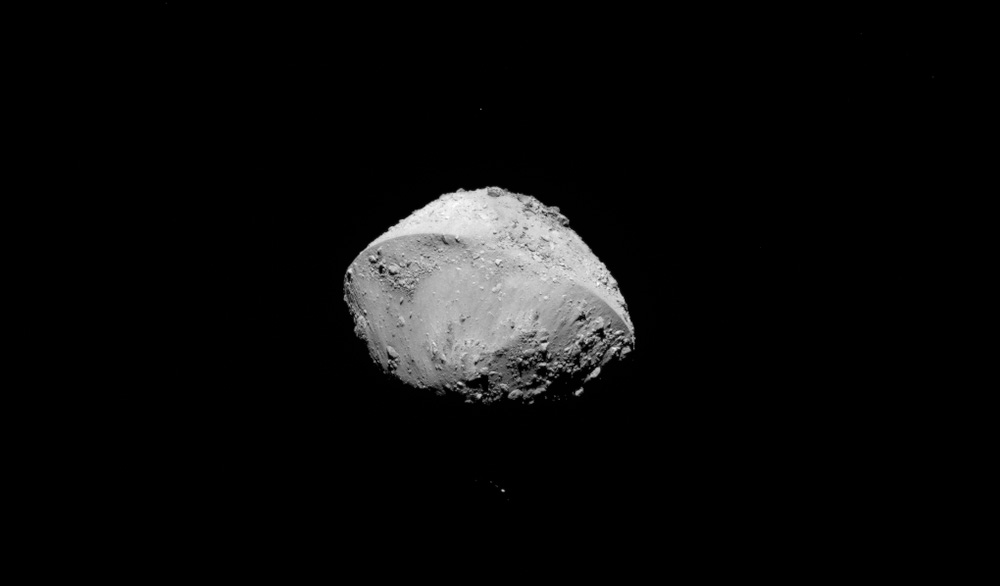
The European Space Agency's (ESA) Hera spacecraft has returned its first images of the binary asteroid system Didymos and Dimorphos. After more than two years in transit, Hera is already giving a taster of the mission's scientific phase. The images were taken with the Asteroid Framing Camera (AFC), for which the German Aerospace Center (Deutsches Zentrum für Luft- und Raumfahrt; DLR) is the scientific lead.
Among other things, Hera is to investigate how the deliberate impact by NASA's DART (Double Asteroid Redirection Test) probe in September 2022 affected the smaller asteroid, Dimorphos, and the surface properties of its neighbour, Didymos. Researchers hope this information will yield important insights for planetary defence from asteroids.
Germany plays a major part in the Hera mission, with the German Space Agency at DLR coordinating the German contributions using federal funds.
The first image was taken by Hera from a distance of approximately 60 kilometres. While Dimorphos, which is about 151 metres in diameter, lies largely in shadow, its larger parent asteroid, Didymos (about 780 metres in diameter), is clearly visible. The image reveals a previously unseen side of Didymos, which the camera on NASA’s DART probe was unable to observe shortly before its impact on Dimorphos.
The second image was captured by the on-board AFC camera system from a distance of 56 kilometres. This image reveals the geological diversity of the larger asteroid’s surface, which includes large boulders, smoother areas and a surprisingly sharp equatorial ridge.
Boulders, craters and striking structures
These first images show a different side of Didymos and Dimorphos from that observed by DART in 2022. Numerous striking surface features can be seen, including large boulders, craters and structures that look like grooves or ridges. The already known ridge along the equator also stands out clearly.
The researchers now want to investigate how these structures formed and whether they could be linked to the DART impact on Dimorphos. When it hit, material was ejected from the surface of the smaller asteroid and some of it may have reached the surface of Didymos, which is only about one kilometre away.
The visible ridge may be caused by the fact that Didymos rotates once every 2.2 hours about its own axis – fast enough to be close to breaking apart. Mathematical models of fast-rotating asteroids suggest that this rotation could cause surface material to flow from higher latitudes towards the equator. It may even be possible that material is flung off the larger asteroid, which may explain the existence of its smaller 'moonlet', Dimorphos. The largely hidden Dimorphos orbits Didymos at a distance of barely more than a kilometre, with some boulders visible on its upper side.
On the trail of the consequences of the DART impact
In September 2022, NASA's DART spacecraft, weighing approximately 500 kilograms, deliberately struck the asteroid Dimorphos at a speed of about 6.1 kilometres per second. The experiment was a success: Dimorphos's orbital period around Didymos was shortened by around 33 minutes – a much greater change than expected. This marked the first time that the motion of a celestial body had been measurably altered by a deliberate, 'human-made' impulse.
Hera will now examine the physical consequences of the DART impact in more detail over at least six months. Objectives include detailing the shape, surface properties and internal structures of both asteroids, and possible changes caused by the impact. The results are intended to help scientists better understand the effect of a 'kinetic impactor'. The deliberate deflection of an asteroid could thus become a predictable method to prevent a catastrophic impact with Earth.
The two AFC cameras are of particular importance for the scientific investigations. Hera will use them to systematically capture and map the surfaces of Didymos and Dimorphos. The images will provide the basis for three-dimensional models of the asteroids and make it possible to analyse striking surface structures and changes.
Detailed images of Didymos and Dimorphos will be released on 25 November 2026. Over the coming months, Hera will carry out a 'crash site investigation' of Dimorphos from close range, using several instruments. Two shoebox-sized CubeSats will also be deployed for an even closer examination, eventually even attempting a landing.
Further information:
Contact:
German Aerospace Center (DLR)
Institute of Space Research
Rutherfordstraße 2, 12489 Berlin
https://www.dlr.de/en/wr
DLR press release, 12 November 2026