• Skip to Page content
  • Skip to Management
  • Skip to Main menu
Charlottenburger Innovations-Centrum (CHIC), WISTA
  • WISTA
  • WISTA.Plan
  • WISTA.Service
  • WISTA direkt
  • Search
    • de
    • en
  • Charlottenburger Innovations-Centrum (CHIC), WISTA
  • Innovation Center
    • Benefits & Team
    • Services
    • Network & Partners
  • Rental Offers
    • Offices
    • Meeting Spaces
    • ST3AM Coworking
  • News / Events
    • Overview
    • CHIC on LinkedIn
  • Company Directory
  • Contact & Location
  • WISTA
  • WISTA.Plan
  • WISTA.Service
WISTA direkt
  • Home Innovation Center
  • News / Events

News / Events

  • Overview
  • CHIC on LinkedIn
  • Home Innovation Center
  • News / Events
19. October 2026

Jupiter space probe JUICE snaps flyby photos of Earth and Moon

Final rehearsal for the instruments ahead of their deployment in the Jupiter system
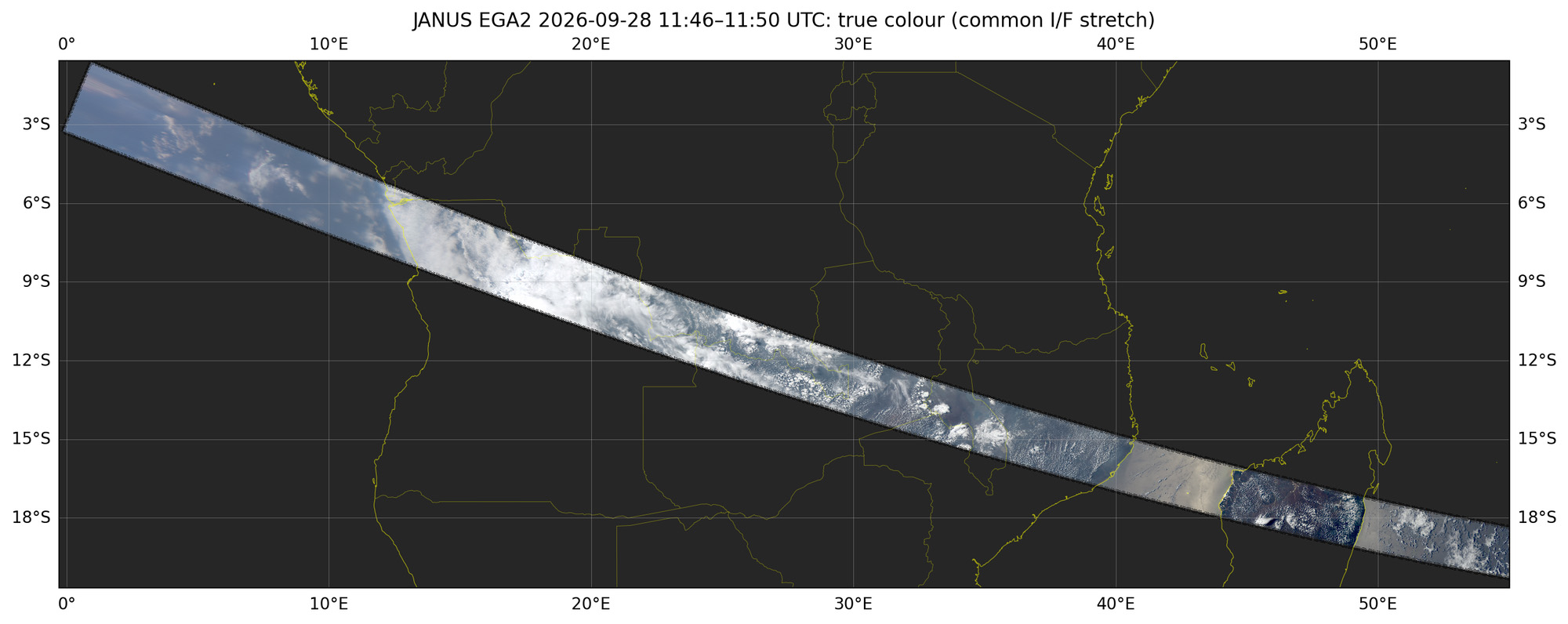
Black map showing the outline of Africa, with a strip of photorealistic Earth’s surface above it
A swath of JANUS observations, approximately 250 to 300 kilometres wide, stretching east of Madagascar across Mozambique, Malawi, Zambia, the Democratic Republic of the Congo and Angola to the Gulf of Guinea. Credit: ESA / JUICE / JANUS team. Processing: L. Penasa

On 28 September 2026, the European Space Agency's (ESA) JUICE (Jupiter Icy Moons Explorer) space probe completed its second Earth flyby manoeuvre, marking another important step on its journey to the Jupiter system. At its closest approach at 13:45 CEST, the probe came within 8640 kilometres of Earth, above the Indian Ocean. The flyby manoeuvre steered JUICE's trajectory further towards Jupiter; a final Earth flyby is scheduled for January 2029.

While passing Earth, JUICE was using our planet’s gravity to adjust its course while, at the same time, testing its instruments ahead of their deployment in the Jupiter system from 2031. The JANUS camera, in which the German Aerospace Center (Deutsches Zentrum für Luft- und Raumfahrt; DLR) plays a key scientific and technical role, took 740 images of Earth and the Moon over several days, enabling the science team to carry out important functional tests, among other things.

JANUS will later investigate the surfaces of Jupiter's moons Ganymede, Callisto and Europa, reveal geological structures and help us to understand the evolution of these 'ice worlds'. The camera will also explore Jupiter's uppermost cloud layers, the planet's thin rings and some of its small, irregularly shaped moons.

The laser altimeter GALA, another instrument on board JUICE led by DLR, also collected valuable data for calibrating the instrument.

Excerpt from the DLR press release, dated 16 October 2026

Full press release with detailed information on the flyby and the ESA mission

Research Traffic / Aerospace Photonics / Optics

Related News

Illustration of the solar system, with a comet passing between the orbits of Mars and Earth

Chance encounter in space: JANUS camera captures interstellar comet 3I/ATLAS

ESA's Jupiter probe, JUICE, was unexpectedly perfectly lined up for observations of a comet from deep interstellar space
Space probe on a platform in a hall where many researchers are working

Worlds made of ice

How cameras and lasers map Jupiter’s moons
The space probe JUICE's trajectory

JUICE space probe to fly by the Moon and Earth

With the close flybys the space probe's trajectory will be changed, setting it on the ideal course to Venus
Jupiter spacecraft © ESA/ATG medialab (spacecraft); NASA/JPL/DLR (Jupiter, moons)

Jupiter Icy Moons Explorer (JUICE) spacecraft with DLR instruments on its way to Europe’s spaceport in Kourou

ESA mission spacecraft launches to Jupiter in April to study the planet and its icy moons, especially Ganymede

Related Institutions

  • Deutsches Zentrum für Luft- und Raumfahrt e.V. (DLR), Standort Berlin

Share this page

  • © WISTA Management GmbH
  • Legal Notice
  • Privacy Policy
  • Digital Accessibility
  • Social Media
  • Contact
Zukunftsorte Berlin Logo, Standort Charlottenburg