
New world record set for the efficiency of a tandem solar cell
A research team from HU and HZB has succeeded in converting 25.5 per cent of sunlight into electrical energy by combining a CIGSe semiconductor layer with perovskite
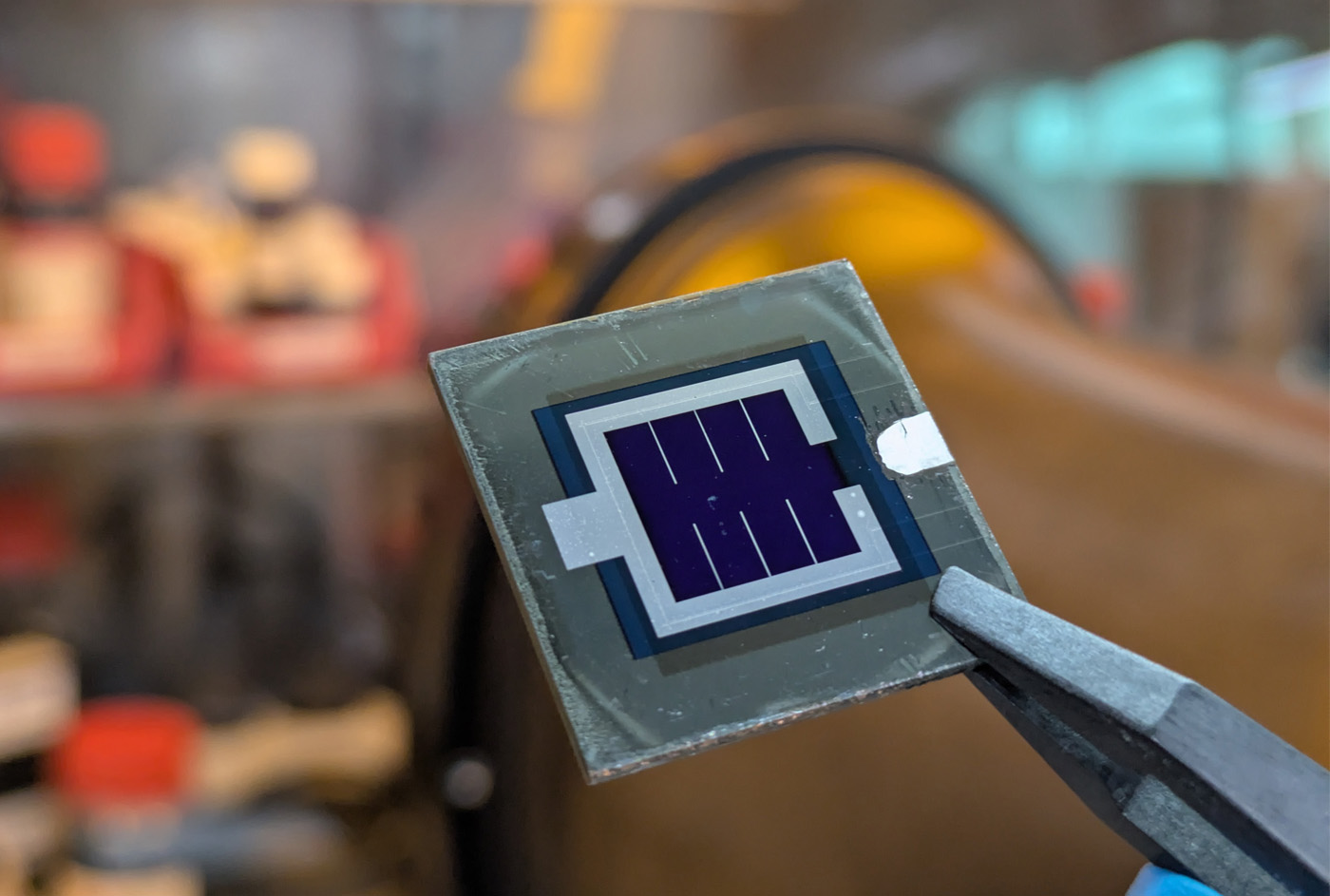
With this record, the Berlin-based team of researchers from the Centre for the Science of Materials Berlin (CSMB) at Humboldt University of Berlin (HU) and the Helmholtz-Zentrum Berlin (HZB) has broken its own record of 24.6 per cent, set last year for this material combination and for a solar cell with an area of more than one square centimetre. The new record was certified by the Fraunhofer Institute for Solar Energy Systems ISE in Freiburg and included in the renowned Solar Cell Efficiency Tables (the so-called ‘Green Tables’). These are regarded as the authoritative reference work for the global photovoltaic community.
“To surpass our previous milestone, we used CIGSe cells with different band gaps and employed two different layer thicknesses of aluminium-doped zinc oxides. We also tested various cell architectures, thereby building on the improvements we had already achieved with our previous record,” says Dr Guillermo Farias Basulto from HZB.
HU Master’s student reduces efficiency losses at interfaces and optimises electrosensitive contacts
The Hybrid Devices research group at the CSMB of HU on the Adlershof campus was also involved in the further development of the tandem solar cell. Wuai Zhang from the CSMB research group and a Master’s student at the Institute of Chemistry at HU investigated numerous combinations of nickel oxide and self-organised monolayers (SAMs) to reduce efficiency losses at the interfaces of the CIGS-perovskite tandem cell and improve the stability of the devices. Zhang also optimised the electron-selective contact, which enables the flow of electric current in the solar cell.
“This record demonstrates how well collaboration in Adlershof works across laboratory boundaries,” says Prof. Dr Emil List-Kratochvil, a physicist and head of the Hybrid Devices research group. The group is conducting research into perovskite materials – semiconducting crystals which, depending on their composition, can be used to manufacture all kinds of microelectronic devices. For their tandem solar cell, the research groups at HU and HZB have combined a CIGS bottom cell with a perovskite-based top cell. By combining two semiconductor thin films to form a tandem solar cell, high efficiencies can be achieved whilst minimising the environmental footprint.
Further information
The latest edition of the Solar Cell Efficiency Tables
Press release HU Berlin, 1 July 2026