• Skip to Page content
  • Skip to Management
  • Skip to Main menu
Charlottenburger Innovations-Centrum (CHIC), WISTA
  • WISTA
  • WISTA.Plan
  • WISTA.Service
  • WISTA direkt
  • Search
    • de
    • en
  • Charlottenburger Innovations-Centrum (CHIC), WISTA
  • Innovation Center
    • Benefits & Team
    • Services
    • Network & Partners
  • Rental Offers
    • Offices
    • Meeting Spaces
    • ST3AM Coworking
  • News / Events
    • Overview
    • CHIC on LinkedIn
  • Company Directory
  • Contact & Location
  • WISTA
  • WISTA.Plan
  • WISTA.Service
WISTA direkt
  • Home Innovation Center
  • News / Events

News / Events

  • Overview
  • CHIC on LinkedIn
  • Home Innovation Center
  • News / Events
22. December 2025

PFAS detection in 15 minutes

BAM develops sensor system for rapid on-site analysis
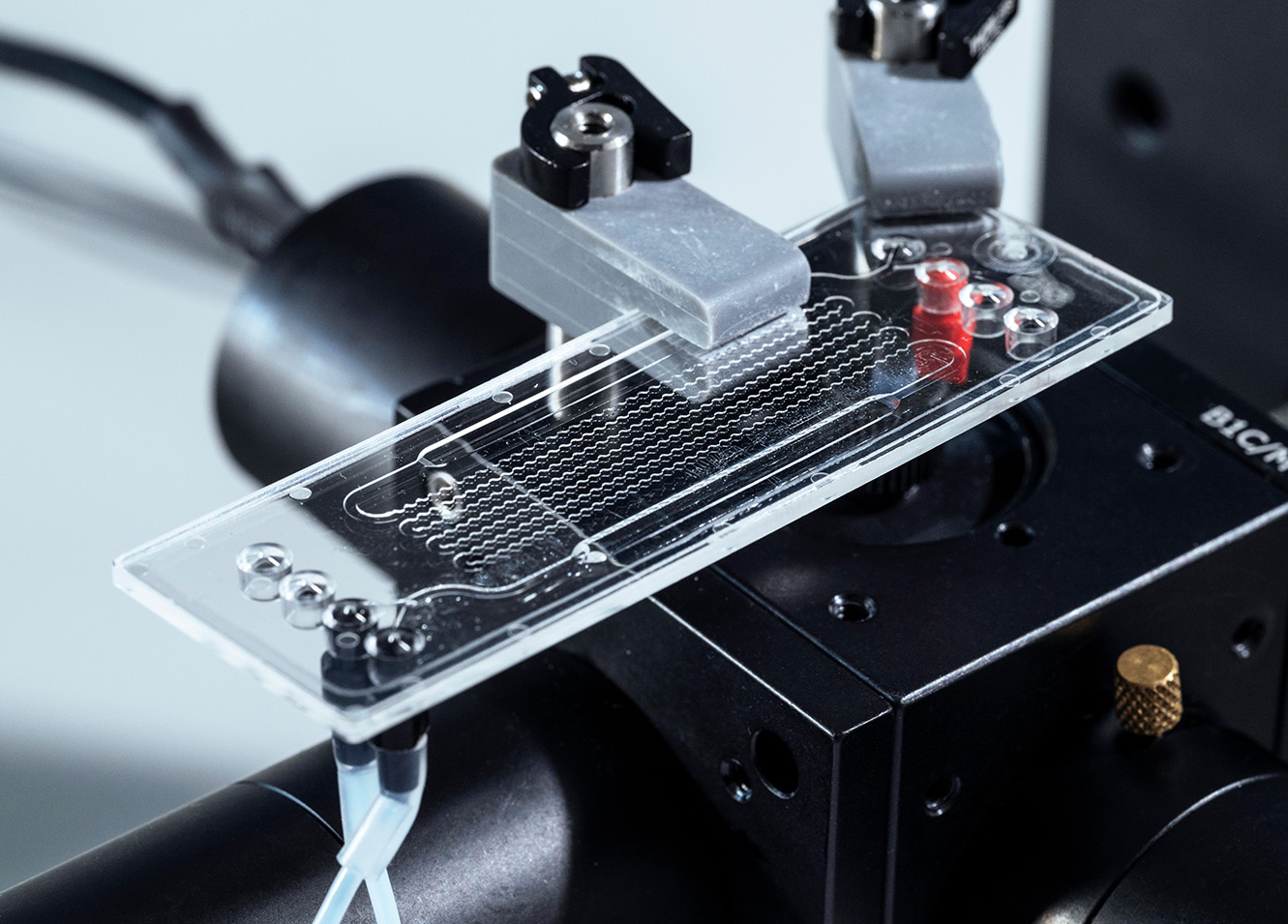
Transparent chip with milled channels.
Close-up of the microfluidic chip of the sensor system. © BAM

PFAS are “forever chemicals” that hardly degrade in the environment. They enter soil and water, accumulate in plants, animals, and humans, and can be harmful to health. The problem: Until now, detecting them has been complicated, expensive, and only possible in a laboratory – too slow for a rapid response.

Researchers at the Federal Institute for Materials Research and Testing (BAM) have now developed a compact sensor system that detects PFAS directly on site in aqueous samples – quickly, reliably, and cost-effectively. The new method delivers results in less than 15 minutes and can detect even small amounts of these chemicals. The results have now been published in the renowned journal Nature Communications and selected for the “Editors' Highlights” section as one of the most important articles of recent months in the field of “Materials Science and Chemistry”.

"PFAS are a global problem. With our technology, we are laying the foundation for rapid on-site analysis that will help authorities and companies monitor and remediate contaminated sites," says Knut Rurack, an expert in chemical and optical sensing at BAM.

The system works with a combination of tiny fluorescent particles and a microfluidic platform – in simple terms, a pocket-sized mini-laboratory. After preparing the water sample, the device shows a clear signal if PFAS are present. “Our goal was to create a robust, user-friendly, and scalable system. The combination of materials science and microfluidics opens up new avenues for monitoring cleaning and remediation processes in the context of environmental management—not only for PFAS, but also for other pollutants,” explains Knut Rurack.

The system is mobile, requires no complex laboratory equipment, and significantly reduces the analysis effort. In this way, BAM is making an important contribution to the protection of people and the environment and supporting the implementation of current legal requirements.

Paper in Nature Communications: „Ratiometric detection of perfluoroalkyl carboxylic acids using dual fluorescent nanoparticles and a miniaturised microfluidic platform“

Contact:

Bundesanstalt für Materialforschung und -prüfung (BAM)
Communications
+49 30 8104-1013
presse(at)bam.de
www.bam.de


BAM press release, 18.12.2025

Analytics Research Biotechnology / Environment Microsystems / Materials Grand Challenges

Related News

Black box containing a test strip, with a smartphone on top displaying green light

Smartphone rapid test detects microbiologically contaminated water in less than a minute

BAM research team developed a highly sensitive detection method for urobilin
Panoramic view of an accelerator lab

Compact electron accelerator for treating PFAS-contaminated water

New approach to breaking down PFAS molecules into harmless components at contamination hotspots using radiolysis
Macro photograph of the material structure

PFAS filter from a ball mill

BAM team develops environmentally friendly material that could help remove these ‘forever chemicals’
Vessel with nitrogen-cooled material particles

BAM develops certified PFAS reference material made from used outdoor clothing

Important step on the road to a circular economy
Symbolic image: Woman at a water dispenser. Source: BAM

Innovative sensor system enables real-time analysis of drinking water

BAM is developing a fast, precise method to detect fecal contamination
Symbolic image: Sewage pipe on the seashore. Source: BAM © Adobe Stock/Planetz

New approach to detect ‘forever chemicals’ in water

A team of researchers from BAM and the University of Birmingham has developed a sensor to detect PFAS in water quickly and easily

Related Institutions

  • BAM Bundesanstalt für Materialforschung und -prüfung

Share this page

  • © WISTA Management GmbH
  • Legal Notice
  • Privacy Policy
  • Social Media
  • Contact
Zukunftsort Charlottenburg Logo