• Skip to Page content
  • Skip to Management
  • Skip to Main menu
Charlottenburger Innovations-Centrum (CHIC), WISTA
  • WISTA
  • WISTA.Plan
  • WISTA.Service
  • WISTA direkt
  • Search
    • de
    • en
  • Charlottenburger Innovations-Centrum (CHIC), WISTA
  • Innovation Center
    • Benefits & Team
    • Services
    • Network & Partners
  • Rental Offers
    • Offices
    • Meeting Spaces
    • ST3AM Coworking
  • News / Events
    • Overview
    • CHIC on LinkedIn
  • Company Directory
  • Contact & Location
  • WISTA
  • WISTA.Plan
  • WISTA.Service
WISTA direkt
  • Home Innovation Center
  • News / Events

News / Events

  • Overview
  • CHIC on LinkedIn
  • Home Innovation Center
  • News / Events
10. October 2025

Watching bandgaps in motion – attosecond interferometry of solids

Research team establishes a broadly applicable, all-optical probe of band-structure dynamics in solids
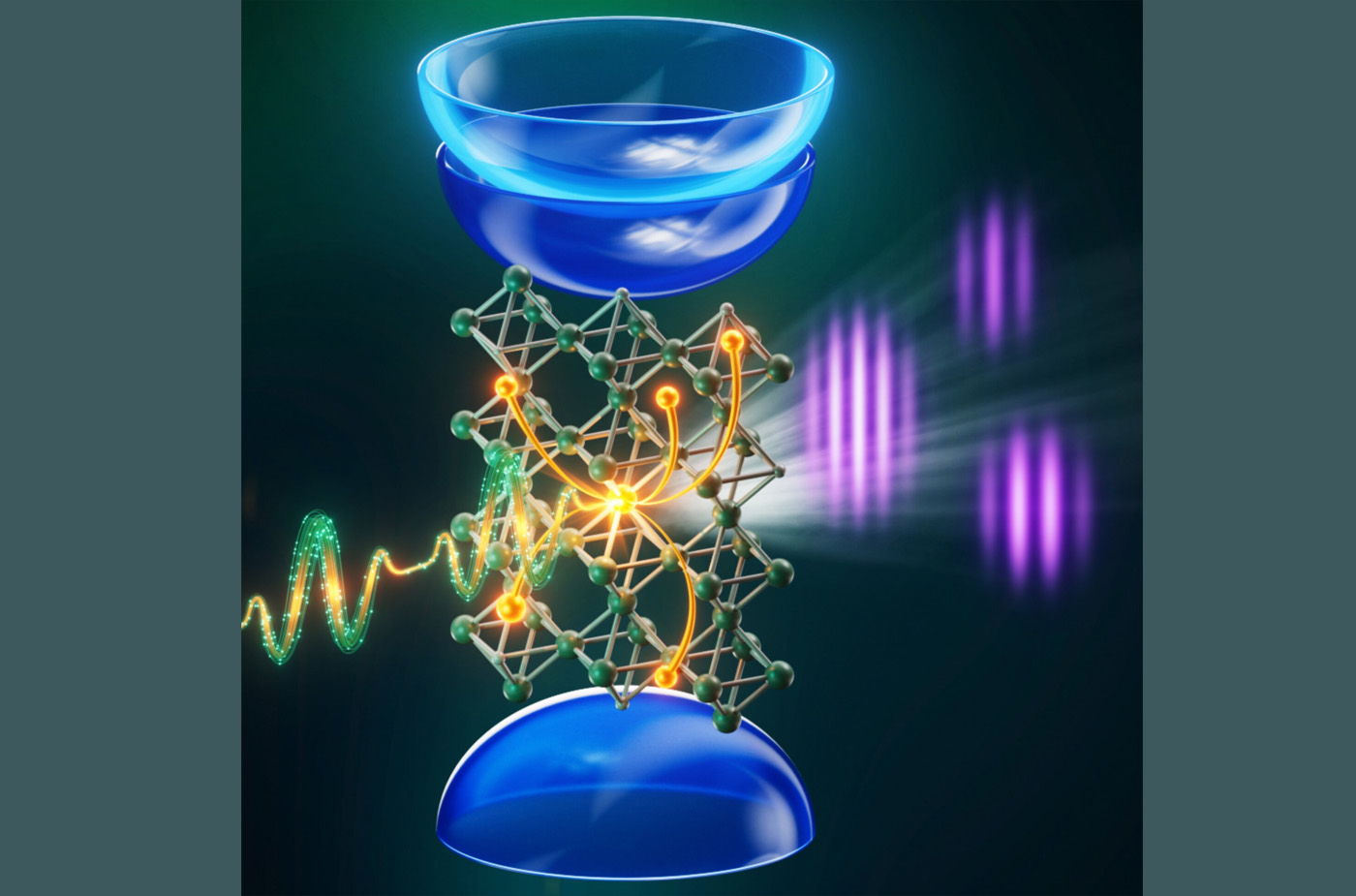
Schematic of high-harmonic interferometry
Schematic of extreme-ultraviolet high-harmonic interferometry of solids: Two phase-locked near-infrared pulses generate high-order harmonics in a solid sample. Interference of the emitted XUV fields encodes transient changes in the electronic bandgap, revealing how strong-field excitation modifies the material’s electronic structure on femtosecond timescales. © MBI

The bandgap, i.e. the energy gap between the highest lying valence and the lowest lying conduction band, is a defining property of insulating solids, governing how they absorb light and conduct electricity. Tracking how a bandgap changes under strong laser excitation has been a long-standing challenge, since the underlying processes unfold on femtosecond timescales and are difficult to track directly, especially for wide-bandgap dielectrics.

In a collaboration between the Max-Born-Insitute, ARCNL Amsterdam, and Aarhus University, researchers have now shown that extreme ultraviolet (XUV) high-harmonic interferometry can provide direct access to such dynamics.

Using pairs of phase-locked near-infrared laser pulses, the team measured interference fringes and their intensity-dependent shift in the generated high-order harmonics from silica glass (SiO2) and magnesium oxide (MgO).

These fringe shifts encode transient changes of the electronic bandgap, with silica showing signatures of a shrinking bandgap, while MgO exhibits a widening.

The experiments were supported by analytical modeling and semiconductor Bloch-equation simulations, confirming that the observed phase variations are consistent with excitation-induced modifications of the electronic structure.

The work establishes interferometric HHG as a broadly applicable, all-optical probe of band-structure dynamics in solids. Beyond fundamental insight, this approach opens pathways toward ultrafast semiconductor metrology and future petahertz electro-optic technologies.

Publication:

Extreme ultraviolet high-harmonic interferometry of excitation-induced bandgap dynamics in solids
Lisa-Marie Koll, Simon Vendelbo Bylling Jensen, Pieter J. van Essen, Brian de Keijzer, Emilia Olsson, Jon Cottom, Tobias Witting,  Anton Husakou, Marc J. J. Vrakking, Lars Bojer Madsen,  Peter M. Kraus, Peter Jürgens
Optica 12, 1606-1614 (2025). URL, DOI oder PDF

Contact:

Max Born Institut for Nonlinear Optics and Short Pulse Spectrocopy
Dr. Tobias Witting
Ultrafast XUV-Physics
+49 30 6392-1228
tobias.witting(at)mbi-berlin.de
mbi-berlin.de


MBI press release, 9 October 2025

Research Photonics / Optics Microsystems / Materials

Related News

Illustration of test setup (a), material layers (b) and X-ray areas (c)

Water Window in the Laboratory

Soft X-ray Imaging with Nanometer Depth Resolution Using High Harmonics

MBI researchers characterise ultrashort VUV light pulses with electron FROG

New technique enables complete analysis of femtosecond pulses in the vacuum ultraviolet range
Ultraviolet photon-counting dual-comb spectrometer

Optical Frequency Combs Make Ultraviolet Spectroscopy More Sensitive and More Precise

New technique enables experiments in the ultraviolet spectral region at very feeble light levels
Figures © MBI

Ultrafast switching with light in correlated materials

Research team manipulates the material’s resistivity with light – a way for opto-electronic ultrafast switching in future microelectronics
Sketch of the experiment ©MBI

Center stage for quantum mechanical entanglement in an attosecond laser laboratory

MBI researchers demonstrate possible link between ultrafast laser spectroscopy and the field of quantum information with pump-probe experiments

Related Institutions

  • Max-Born-Institut für Nichtlineare Optik und Kurzzeitspektroskopie im Forschungsverbund Berlin e.V. (MBI)

Share this page

  • © WISTA Management GmbH
  • Legal Notice
  • Privacy Policy
  • Social Media
  • Contact
Zukunftsort Charlottenburg Logo