
X-rays reveal a fleeting step in a light-excited molecule
Combining measurements from three facilities helps clarify how an iron-containing molecule rearranges its electrons after absorbing light
A collaboration between Helmholtz-Zentrum Berlin (HZB), the Paul Scherrer Institute (PSI) in Villigen, Switzerland, and European XFEL has traced how a molecule rearranges its electrons when excited by light. The findings, published in Angewandte Chemie, help clarify a long-standing question and open new possibilities for studying chemistry in motion, such as bonds breaking or forming—fundamental steps in reactions involving catalysts and biological molecules.
How does a molecule respond immediately after absorbing light? Quantum mechanics forbids transitions involving a change in electron spin. But in molecules containing metals such as iron, the electrons can still switch to a state with a different spin. Therefore the first steps after absorbing light are still a matter of scientific debate. Combining complementary X-ray techniques, the researchers have detected a short-lived intermediate state with a different electron spin in an iron-containing molecule’s response to light. In the experiment, a laser pulse causes the iron’s electrons to rearrange and the iron–nitrogen bonds to stretch. The scientists followed these dynamics from the perspective of the nitrogen atoms: they took snapshots using X-ray pulses arriving at different delays after the optical laser had excited the molecule. This made the process visible and revealed how the changes unfold.
Researchers had debated whether the molecule moves directly into a longer-lived excited state or briefly occupies an intermediate electronic configuration. The measurements support the intermediate step, appearing during the first 400 femtoseconds—less than half a trillionth of a second. “We can see these changes in the outer electrons—the electrons that actually participate in chemistry,” says Alexander Föhlisch of HZB.
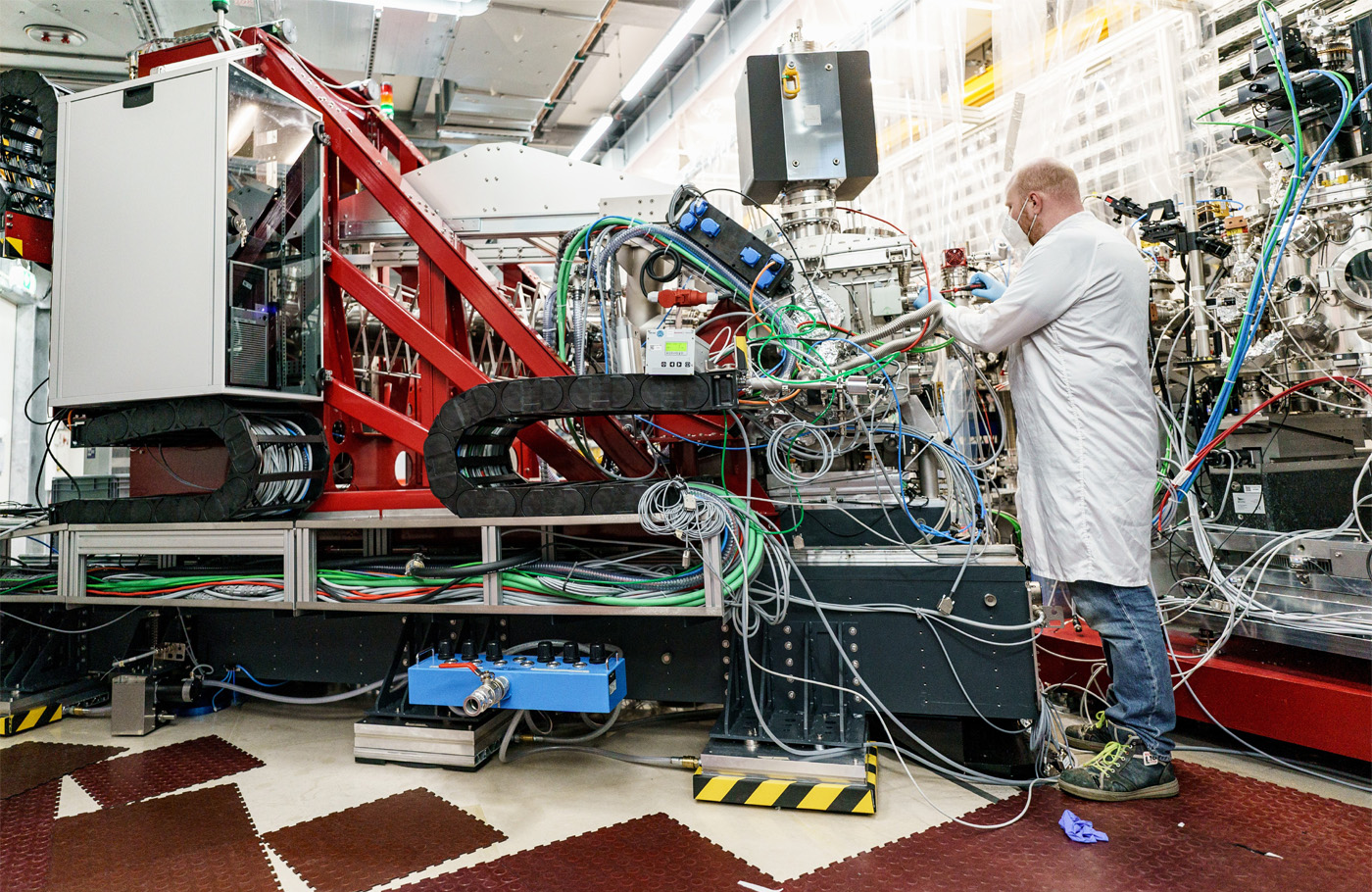
The collaboration brought together complementary views of the same process. At the X-ray free electron laser SwissFEL at PSI, researchers measured changes in X-ray absorption. At European XFEL, they analysed the energy of scattered X-rays at the innermost electron shell of the nitrogen atoms, using the high-resolution hRIXS (Heisenberg resonant inelastic X-ray scattering) spectrometer for the first time. Measurements at HZB’s Bessy II synchrotron provided reference data, while HZB researchers led the development of the hRIXS spectrometer in a European XFEL users consortium. “The absorption measurements show us where changes occur,” explains Sebastian Eckert of HZB. “With the scattering measurements, we can then examine the short-lived electronic states in more detail.”
“This study lays the groundwork for investigating more complex chemical systems”, says Benjamin Van Kuiken, scientist at the SCS instrument at European XFEL. Beyond this particular molecule, the approach could help researchers connect electronic changes with atomic motion during chemical reactions.
Author: Thomas Reintjes, European XFEL
Publication:
Angewandte Chemie, international Edition (2026): Tracing Structural Distortions and Orbital Population During Spin-Crossover in Transition Metal Complexes via Ligand K-edge Spectroscopy
Sebastian Eckert, Benjamin E. Van Kuiken, Andre Al Haddad, Vinícius Vaz da Cruz, Wagner Ribeiro da Silva Neto, Leo Cordsmeier, Annette Pietzsch, Mattis Fondell, Yi-Ping Chang, Natalia Gerasimova, Justine Schlappa, Robert Carley, Giuseppe Mercurio, Teguh Citra Asmara, Cammille Carinan, Gregor Knopp, Kirsten Schnorr, Xinhua Xie, Antoine Sarracini, Jonas Knurr, Eloisa F. Manetti, Suddhasattwa Mandal, Loïc L. C. Bassement, Christoph Bostedt, Andreas Scherz, Alexander Föhlisch
DOI: 10.1002/anie.1660388
Contact:
Dr. rer. nat. Sebastian Eckert
Helmholtz-Zentrum Berlin für Materialien und Energie
Institute Methods and Instrumentation for Synchrotron Radiation Research
+49 30 8062-14465
sebastian.eckert(at)helmholtz-berlin.de
Prof. Dr. Alexander Föhlisch
Helmholtz-Zentrum Berlin für Materialien und Energie
Institute Methods and Instrumentation for Synchrotron Radiation Research
+49 30 8062-14985
alexander.foehlisch(at)helmholtz-berlin.de
Andre Al Haddad
Paul Scherrer Institute
SwissFEL Maloja Experimental Station
+41 56 3104159
andre.al-haddad(at)psi.ch
Benjamin Van Kuiken
European XFEL GmbH
+49 40 8998 6545
benjamin.van.kuiken(at)xfel.eu
www.xfel.eu
HZB press release, 19 November 2026